
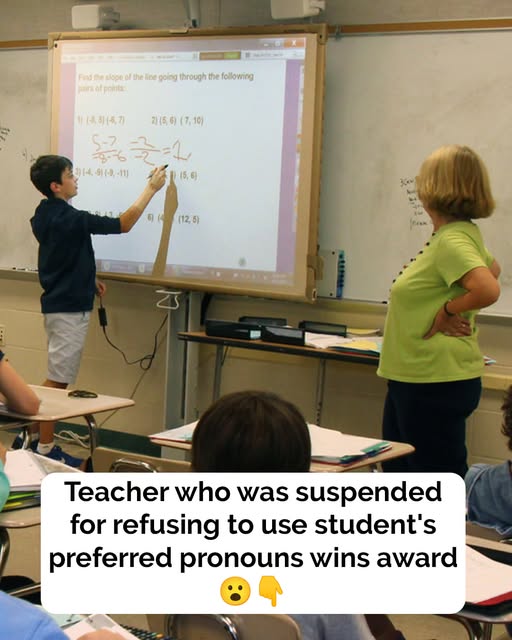
Teacher Suspended for Rejecting Preferred Pronouns Wins Big in Court
A Case That Sparked National Debate
The topic of Teacher Suspended raises many questions. A Kansas middle school teacher who was suspended after refusing to use a student’s preferred pronouns has won a significant legal victory, sending shockwaves through the education community and reigniting the national debate over religious freedom, gender identity, and the rights of teachers in the classroom.
Education
Pamela Ricard, a former middle school math teacher who worked at Fort Riley Middle School in Kansas since 2005, found herself at the center of a firestorm in 2021. She was suspended after addressing a biologically female student by the student’s legal and enrolled last name, according to NBC News. Despite being told by a school counselor that the student preferred an alternative first name, Ricard put her faith first.
Believing that God assigns gender at birth and that using language contrary to the student’s biological sex actively violates her commitment to religion, Ricard rejected the requests to use the student’s preferred first name. Instead, she started calling the pupil by their last name, preceded by the gendered title “miss,” thinking she had found a compromise that respected both the student and her religious convictions.
The Legal Battle
Though there was no formal policy in place on gender pronouns at either the school or the district at the time, Ricard was suspended under the district’s bullying and diversity and inclusion policies. This did not sit well with the veteran teacher, who asked three times for a religious exemption to the policy, arguing that her beliefs were never accommodated. The school district maintained that its policies were designed to protect all students from discrimination, but Ricard argued that her constitutionally protected religious beliefs were being violated.
Language Resources
In 2022, Ricard filed a federal lawsuit outlining her claims that the Geary County School District violated her constitutional rights to free speech, free exercise of religion, due process, and equal protection under the law. The lawsuit also alleged that her Christian beliefs were not considered when the district suspended her for three days without pay. Additionally, the filing claimed that teachers were told to conceal a student’s preference by using legal names when addressing parents, if that was the student’s wish, effectively requiring educators to deceive parents about their own children.
“No school district should ever force teachers to willfully deceive parents or engage in any speech that violates their deeply held religious beliefs,” said Tyson Langhofer, the director of the Alliance Defending Freedom, a conservative Christian legal group that filed the lawsuit alongside Ricard’s legal team. Josh Ney, one of her attorneys, added: “Our suit contends that schools cannot force teachers to promote novel views about gender fluidity and ever-expanding pronoun categories without regard to the First Amendment or due process.” Ney further emphasized that throughout her career, Ricard had consistently treated every student in her classroom with respect and dignity, but the school district had not treated her with similar good faith or basic fairness.
Courts & Judiciary
The lawsuit drew national attention, with conservative media outlets covering the case extensively as an example of religious persecution in public schools, while progressive voices argued that the teacher’s actions constituted discrimination against a vulnerable student. The case became a flashpoint in the broader culture wars over transgender rights, with both sides watching closely for the outcome.
The Settlement
Only six months after suing the district, Ricard claimed a victory with a $95,000 settlement. The Geary County School District unsuccessfully tried to convince a federal court that a teacher should completely avoid using a child’s name during a parent-teacher conference in order to hide new names and genders being used by the school for a child in a classroom. “Absurdity and deception has its limits, especially in federal court,” Ney said, adding that after the ruling, the school district revoked the parental communications policy that put the requests of students first. The district’s attempt to defend such a practice was widely criticized as unreasonable and legally untenable.
Legal
As part of the settlement, the district scrubbed Ricard’s records and issued a statement confirming that she was in good standing without any disciplinary actions. The agreement essentially erased the suspension from her employment history, allowing her to retire with a clean record after nearly two decades of service at Fort Riley Middle School. The $95,000 settlement compensated her for the violation of her rights and served as a deterrent to other school districts considering similar policies.
I’m glad the case clarifies the financial stakes for school boards if they attempt to force teachers to lie to parents about their students, Ney said after the settlement was announced. The message to school districts was clear: policies that infringe on teachers’ constitutional rights can carry significant financial consequences.
Teacher Suspended: Public Reaction and Broader Implications
The case generated intense reactions on social media, with many users rallying behind Ricard and offering their support and praise. “This is just wrong. This teacher is not responsible for these silly and dangerous ideas. Glad she is standing her ground. Need more like her!” one commenter wrote on a Facebook post announcing the settlement. Another added: “Thankful for this teacher for standing up for what’s right,” while a third commented: “Horrible! So glad she won her right to be a woman of honor and trust.” The overwhelming majority of comments on social media platforms expressed support for the teacher’s position.
Educational Resources
The case highlights the growing tensions between LGBTQ advocacy groups pushing for inclusive policies in schools and religious conservatives who argue that such policies infringe on their First Amendment rights. The settlement sends a clear signal to school districts across the country that forcing teachers to choose between their religious beliefs and their jobs can have significant legal and financial consequences. School boards are now being advised by legal counsel to carefully consider the constitutional implications of their pronoun policies before implementing them.
Constitutional Law & Civil Rights
Legal experts have noted that the case could have far-reaching implications for how school districts handle similar situations in the future. The fact that the district did not have a formal pronoun policy in place at the time of the incident was a significant factor in the case, and many schools have since moved to establish clear guidelines to avoid similar legal challenges. However, the tension between protecting student rights and respecting teacher religious beliefs remains unresolved in many jurisdictions.
Education
The debate over pronoun usage in schools continues to be one of the most contentious issues in American education, with no easy resolution in sight. Cases like Pamela Ricard’s serve as a reminder of the complex legal and ethical questions that arise when religious freedom, gender identity, and educational policy intersect. As more states pass laws on both sides of this issue, the legal landscape continues to shift, and further court battles are almost certain in the years ahead.
