I’ll tell you what I did wrong the first time.
Discover more
Writers Resources
Babies
People & Society
I panicked.
I grabbed a flashlight and a leash and ran out of the house barefoot in shorts and a T-shirt. I called her name. I ran up and down the block. The rain was coming sideways by then. I slipped on the sidewalk twice.
Forty-five minutes in, my phone rang.
It was a number I didn’t recognize. A woman’s voice. “Sir, is your dog a brindle Pit Bull with a black collar and a Tulsa County tag?”
Dogs
Discover more
Visual Art & Design
babies
Babies & Toddlers
I said yes.
She said, “She’s on my porch on East 21st. She’s fine. She’s dry. She came up and rang my wind chime with her nose.”
I drove there in the rain. Ruby was sitting on a stranger’s covered porch with her tongue out. She got in the car without a complaint. She went to sleep on the floorboard.
I fixed the fence the next day with two extra boards and a row of metal brackets across the top.
Four nights later, another storm came through.
She broke through the fence again.
This time it took her two hours to turn up. A different stranger, ten blocks away, found her in his carport.
Discover more
Time & Calendars
dog
babies
I added a second row of brackets. I added an electric wire along the top. I felt bad about the electric wire.
Three weeks later, on a Thursday night in May, a thunderstorm came in at 10:47 p.m., and my dog cleared the electric wire without slowing down.
Dogs
I grabbed my phone, my keys, my raincoat, and the leash. I got in the truck. I started driving.
I drove in circles. Six blocks. Ten blocks. Twenty. I couldn’t find her.
At 11:30 p.m. I pulled over under an overpass on Highway 169 about two miles from my house to wipe the windshield with my sleeve because the defroster had stopped keeping up.
Discover more
How-To, DIY & Expert Content
Babies
Pets & Animals
That’s when I saw her.
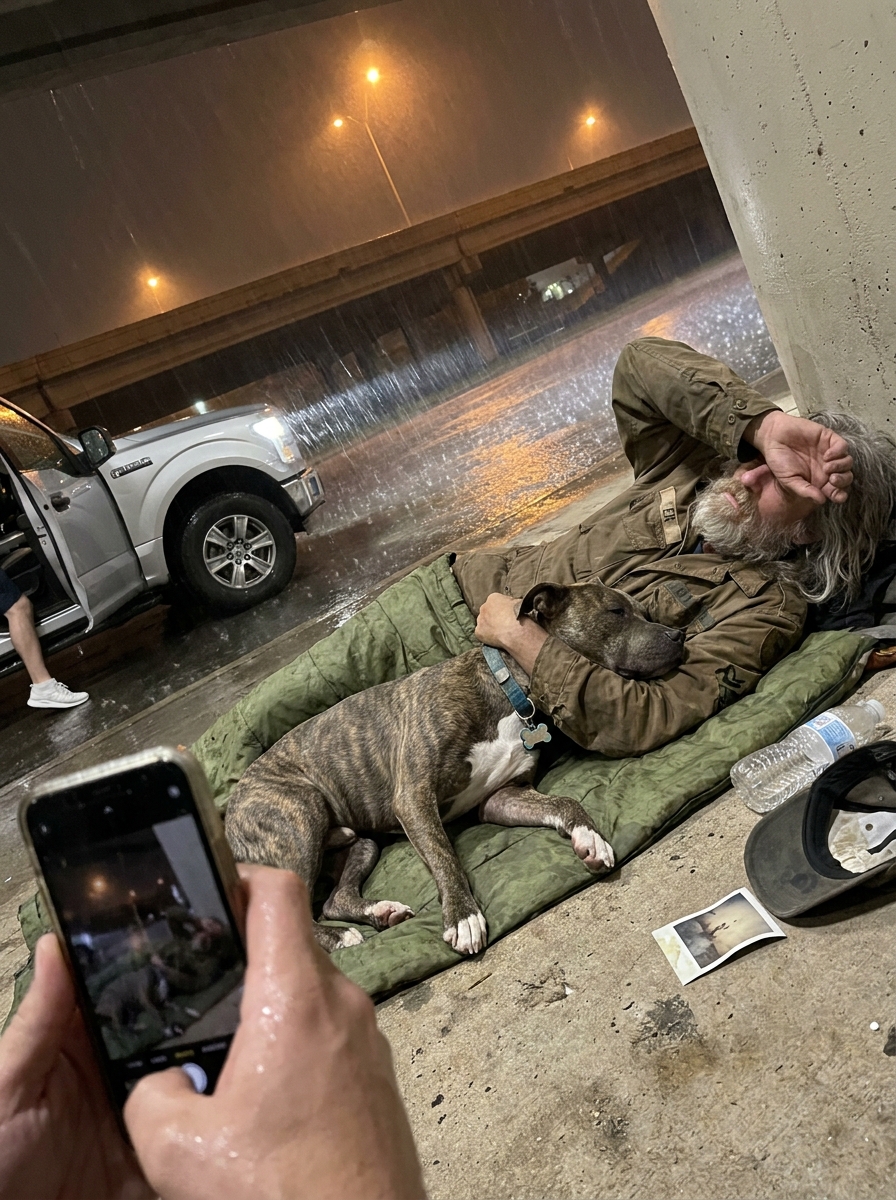
Ruby was about forty yards away, in the dry concrete triangle where the on-ramp meets the overpass underside. The rain was coming down in sheets on either side of the overpass. The ground under it was dusty and dry and warm from the day’s heat.
There was a man lying on a rolled-up sleeping bag.
He was facedown, his arms crossed over his head, his shoulders shaking. He was making a sound I could hear even over the rain. A kind of low ragged sound that was not crying but was close.
Ruby was on top of him.
Not sitting next to him. Not curled up beside him.
Discover more
Writers Resources
Babies & Toddlers
People & Society
On his chest. Lengthwise. Her full sixty-five pounds. Her head tucked under his chin. Her front paws spread across his upper arms. Her body completely still.
The man had one hand on the back of her neck.
She was not moving. She was breathing slow.
She knew exactly what she was doing.
I got out of the truck.
I walked toward them through the rain.
The man lifted his head when I was about twenty feet away. He was maybe fifty years old. Long gray beard. Thin. A Vietnam-era Army field jacket with a name tape I couldn’t read from where I was.
His eyes focused on me.
Then on Ruby.
Then back on me.
He said, very quietly, “She yours?”
I said, “Yeah. I’ve been looking for her for an hour.”
He said, “Mister.”
He paused.
He said, “I think you got the wrong idea about your dog.”
Dogs
His name was Earl.
He was fifty-three years old. He’d served two tours in Iraq in the late nineties, gotten out as a Sergeant First Class, had a wife and a kid once in a house in Broken Arrow, and somewhere in the twenty years since, had ended up sleeping under an overpass in Tulsa because his head would not let him be inside walls when it stormed.
He didn’t tell me all of this that first night. He told me most of it over the next three months.
That first night he just told me about the dog.
He said, “Mister. Your dog started showing up here about five weeks ago. First time I thought it was a stray. She walked right up to me in the rain and lay down on my chest. I didn’t know what to do. I let her. She stayed about two hours. Then she left.”
He said, “Next storm, she came back. Same thing. Lay on my chest. Stayed till I could breathe.”
He said, “Third storm, I started waiting for her. I’d lay down when the thunder started because I knew she was coming.”
He said, “I call her Sergeant. That’s not a pet name. That’s a job title. I was a K-9 handler for six months in Iraq. That’s what the dogs did when a handler started breaking down. Lay on the chest. Full weight. Slow the breathing. They called it grounding. She does it like somebody taught her. I don’t know who did.”
I looked at Ruby, still on his chest.
I said, “She’s a shelter dog. I don’t know her history before two years ago.”
Earl said, “Yeah. I figured.”
He looked down at her.
He said, “Mister. I don’t know your dog’s deal. I don’t know if she’s part service dog, or if she just knows what she knows. But I’m gonna tell you — the last three times I’ve had a bad storm, she’s the only thing that’s kept me from doing something stupid. I don’t mean to her. I mean to me.”
I didn’t know what to say.
I stood in the rain under an overpass in Tulsa, Oklahoma, at midnight, looking at a dog I had owned for two and a half years, who had been running two miles through thunderstorms to keep a stranger alive, and I realized I had no idea who she was.
I said, “Earl, I’m gonna leave her here with you tonight.”
He said, “You sure?”
I said, “I’m sure. I’ll come back in the morning.”
He nodded.
He put his hand back on the back of her neck.
Ruby didn’t move.
I drove home in the rain and sat on my couch in wet clothes for an hour without turning on the TV.
I came back at 6:30 a.m.
Earl was sitting up, leaning against a concrete pillar, drinking coffee from a thermos a church volunteer had left him the day before. Ruby was asleep with her head on his thigh.
He waved me over.
He said, “She slept through the rest of the storm. I slept too. First time in three weeks.”
I sat down on the concrete next to him.
We talked for two hours.
He told me he’d been on the streets for nine years. He told me the VA had sent him a therapist twice but he couldn’t keep appointments because he couldn’t read the letters they sent. He told me his wife had died of cancer in 2017 and he hadn’t known how to explain to their daughter why he couldn’t come to the funeral.
Then he told me the part I wasn’t ready for.
He said, “Mister. Your dog is wearing a blue collar. There was a tag on it the first time she came. I took a picture with a throwaway phone a buddy gave me. I figured somebody’d want to know where their dog was.”
Dogs
He showed me the picture. It was Ruby’s original tag from the shelter. It said her intake name.
Her intake name wasn’t Ruby.
Her intake name, stamped on the metal, was SGT.
I stared at it.
I hadn’t looked at her old tag in two and a half years. The shelter had given her a new name at some point and I’d changed it again when I got her.
I said, “Earl. Did you know her old name?”
He said, “Not till after. I knew my own name for her first. I called her Sergeant because of what she was doing. Second time she came, I read her tag. I didn’t know what to do with that.”
He looked at me.
He said, “I think somebody trained her for this, mister. Before the shelter. I don’t know who. I don’t know why she ended up with a family moving out of state. But she didn’t forget.”
He scratched behind her soft floppy ear.
He said, “She’s still working.
