
My son Mason has always noticed things long before most people realize there is anything to notice.
Discover more
Inspirational quotes posters
Newsletter subscription service
Pregnancy & Maternity
I first understood that when he was three.
Ryan and I had been arguing in the kitchen about something I can’t even remember now. At the time, it had probably felt important. Most married arguments do while they’re happening.
Mason stood silently in the doorway.
He didn’t cry.
Discover more
Legal services wills
Special Occasions
Inheritance planning guide
He didn’t interrupt.
He just watched.
After Ryan left for work, I started washing dishes with far more force than necessary.
LanguageResources
Mason came over and stood beside me.
“Mom?”
“Yeah, buddy?”
“Your hands are too tight.”
I looked down.
My fingers were gripping the plate so hard my knuckles had turned pale.
He was three years old.
He couldn’t explain tension or resentment or emotional exhaustion.
But he could see it.
So I loosened my grip.
“Thank you.”
Discover more
Marriage
Food & Drink
Life story books
“Okay.”
Then he walked back to his toys.
That was Mason.
He noticed what people carried even when they didn’t say it out loud.
He watched how people treated each other.
He noticed the difference between words and actions.
And by the time he was ten, he had been watching his father and me for years.
That matters because of what happened at the beach.
My name is Claire Donovan.
I’m thirty-eight years old, and I married Ryan eleven years ago.
Discover more
Celebrity news updates
family
Child Care
When we first met, he made me feel like the most important person in every room.
Ryan was charismatic.
He remembered details.
He planned surprises.
He listened closely enough that when he brought something up weeks later, I felt genuinely seen.
And I believe he loved me.
I still believe that.
The problem was that somewhere along the way, the center of our marriage slowly shifted.
Not all at once.
That would have been easier to notice.
It happened through dozens of tiny adjustments.
His career mattered a little more.
His schedule became the one we planned around.
His comfort became the default.
His work relationships became urgent.
His image became something everyone else was expected to help maintain.
Meanwhile, I became the person who handled whatever he didn’t want to think about.
I packed.
I planned.
I remembered.
I organized.
I made excuses.
Ryan wasn’t cruel.
That’s important.
He wasn’t deliberately trying to diminish me.
He had simply grown accustomed to the fact that I would carry whatever he put down.
Eventually, he stopped noticing how much I was carrying.
The company beach picnic had been on our calendar for weeks.
Ryan talked about it constantly because his boss, Lauren, would be there.
He wanted a promotion that fall, and Lauren’s recommendation mattered.
“I just want her to see that I’m relaxed outside work,” he told me in the car.
“That I’m easy to be around. Stable. Family-oriented.”
Family-oriented.
I almost laughed.
That morning, I had packed everything myself.
Sandwiches.
Fruit.
Drinks.
Towels.
Sunscreen.
Mason’s football.
The cooler was so heavy I could barely drag it across the kitchen.
Ryan was standing nearby looking at his phone.
“Can you help me with this?” I asked.
“I’ll start the car.”
Then he walked outside.
Mason immediately grabbed the other handle.
Together, the two of us carried the cooler.
Halfway to the car, he glanced at me.
“Dad didn’t help.”
“He’s getting the car ready.”
Mason said nothing.
But I could tell he was filing it away.
At the beach, Ryan walked ahead of us carrying exactly one thing.
His phone.
I hauled the cooler across the sand while Mason stayed beside me.
Once we found Ryan’s coworkers, we set up our area.
Ryan took the best chair.
Mason and I spread out the blanket.
By the time everything was ready, I was sweating.
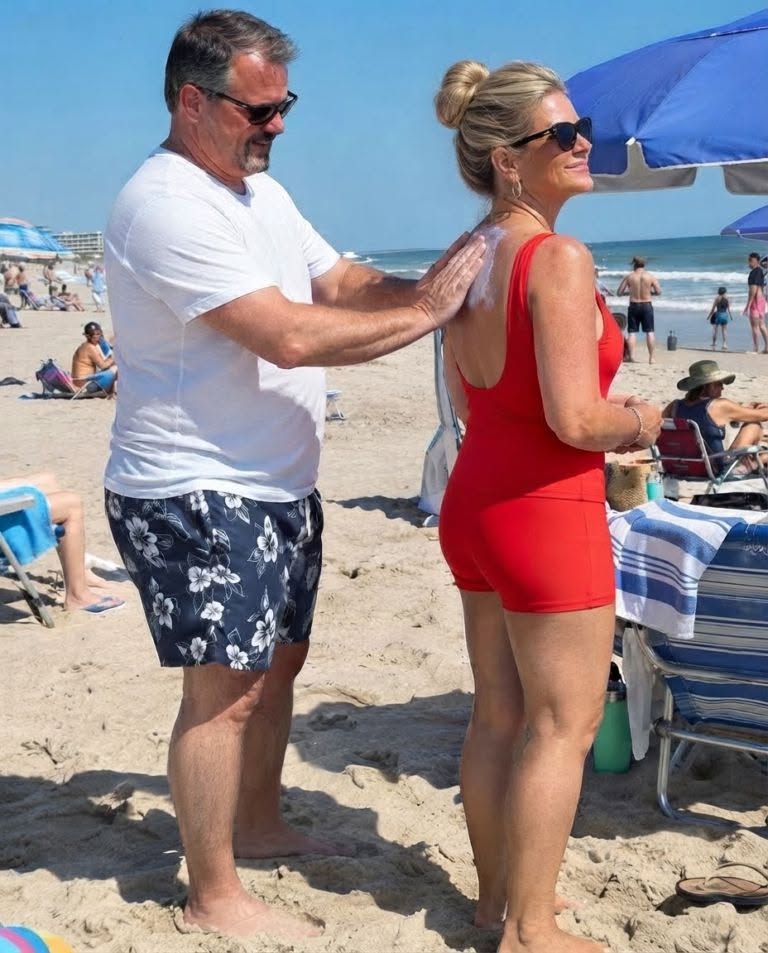
I took off my cover-up and reached for the sunscreen.
“Ryan, can you put some on the middle of my back? I can’t reach.”
He barely looked at me.
“Seriously? I feel terrible. This heat is killing me.”
“It’ll take ten seconds.”
He sighed dramatically.
“Claire, I said I don’t feel good. My head hurts. I need to cool down.”
So I put sunscreen everywhere I could reach and left the middle of my back uncovered.
LanguageResources
Twelve minutes later, Lauren arrived.
Ryan stood up immediately.
His headache apparently vanished.
“Lauren, let me get your bag.”
He hurried over to her.
The same man who had watched me struggle with the cooler suddenly had plenty of energy.
Lauren mentioned that she had forgotten to put sunscreen on her back.
Ryan grabbed our bottle.
“You’ll burn. Turn around.”
Then he carefully applied sunscreen across her shoulders.
He even asked whether he had missed any spots.
When she complained about the sun being in her eyes, he moved our umbrella.
When she wanted a drink, he brought her one from the cooler I had carried.
He wasn’t sick.
He had never been sick.
When he came back, I looked at him.
“I thought you didn’t feel well.”
His expression changed immediately.
“Don’t start.”
“You were too sick to help me for ten seconds, but suddenly you’re fine doing the exact same thing for Lauren?”
“She’s my boss.”
“So?”
“Claire, don’t embarrass me.”
I stared at him.
Then he said the sentence he always used whenever I named something uncomfortable.
“You’re overreacting.”
I felt my face burn.
Not because of the sun.
What neither of us realized was that Mason had heard the whole exchange.
He had watched his father refuse to help me.
He had watched Ryan rush to help Lauren.
He had watched him move the umbrella.
Bring her a drink.
Then tell me I was jealous and dramatic.
Mason didn’t say anything.
He sat beside our beach bag and started searching through it.
A little while later, Ryan stretched out comfortably in the lounge chair.
Apparently, his terrible headache had completely disappeared.
Then he called over to me.
“Claire, can you bring me something cold? I’m roasting.”
I automatically started to stand.
That was how trained I had become.
But Mason grabbed my arm.
“I’ll help Dad.”
There was something different in his voice.
Not anger.
Not mischief.
Certainty.
He reached into the beach bag, pulled out a bottle of ice-cold water, and walked toward Ryan.
I assumed he was going to hand it to him.
He didn’t.
Mason stopped beside the chair.
Then he turned the entire bottle upside down over his father’s head.
Ryan shouted so loudly that half the beach turned around.
He jumped out of the chair, soaking wet.
“What the hell are you doing?”
Everyone was looking now.
Lauren.
Ryan’s coworkers.
Their spouses.
Their children.
Everyone.
Mason stood perfectly still.
“Teaching you some manners, Dad.”
Ryan stared at him.
“Mason. Come here. Now.”
“No.”
Ryan looked almost more shocked by that than by the water.
“Excuse me?”
Mason remained calm.
“You told Mom you were too sick to put sunscreen on her back.”
Nobody moved.
“Then Lauren came, and suddenly you weren’t sick anymore.”
Ryan’s face tightened.
Mason continued.
“You put sunscreen on Lauren. You moved the umbrella for her. You brought her a drink.”
Then he pointed toward me.
“Mom carried that cooler all the way across the beach.”
Ryan said nothing.
“And after all that, you told Mom she was embarrassing you.”
The entire group was silent.
Mason looked straight at his father.
“You should apologize to her.”
“Mason—”
“Say sorry to Mom.”
Then Lauren spoke.
“Ryan.”
Just his name.
But the way she said it made everyone understand immediately that this wasn’t going away.
Ryan looked at her.
Lauren’s expression was serious.
“Your son is right.”
That was all she said.
Ryan turned toward me.
I was standing near the blanket, completely frozen.
“Claire.”
For once, my name sounded different in his mouth.
Not irritated.
Not dismissive.
He looked embarrassed, yes.
But underneath that was something else.
Recognition.
“I’m sorry.”
I didn’t answer.
He swallowed.
“I’ve been treating you like you only matter when I need something.”
There it was.
Out loud.
In front of everyone.
No excuses.
No accusation that I was being emotional.
No attempt to change the subject.
I simply said, “Yes.”
He nodded.
“I have.”
Mason watched him carefully.
Ryan looked at his son.
“You were right.”
Mason didn’t smile.
Ryan continued.
“You shouldn’t have had to do that. But I’m glad you did.”
Mason thought about it.
Then he nodded.
“Okay.”
A few seconds passed.
“Can I have a sandwich now?”
I burst out laughing.
I couldn’t help it.
After everything that had just happened, Mason was finished.
He had said what needed saying.
Now he wanted lunch.
I handed him a sandwich.
He sat beside me and started eating like he hadn’t just publicly dismantled his father’s entire self-image.
A little while later, Lauren walked over.
She didn’t go to Ryan.
She came to me.
“Can I say something?”
“Sure.”
“I didn’t know.”
“About what?”
“When I asked about sunscreen, I didn’t know he had just refused to do the exact same thing for you.”
“I know.”
“If I had known, I never would have asked.”
“I know.”
She looked toward Mason.
“Your son is remarkable.”
I smiled faintly.
“I have a daughter his age,” she continued. “I hope she would stand up for me like that.”
Then she looked toward Ryan.
“I don’t know anything about your marriage. That’s not my business.”
She paused.
“But I do know that the version of himself Ryan presents as a husband and father didn’t match what I saw today.”
I looked down.
Then Lauren said something I still remember.
“And the clarity Mason showed? Children learn that somewhere.”
She looked at me.
“He learned it from you.”
For a moment, I couldn’t speak.
“Thank you.”
“I mean it.”
Then she walked away.
About forty minutes later, Ryan returned and sat beside me.
For a while, neither of us said anything.
We watched Mason throwing the football around in the shallow water.
Finally, Ryan spoke.
“How long?”
I turned toward him.
“How long what?”
“How long have I been like this?”
I thought about it.
“A while.”
He nodded.
“I didn’t notice.”
“I know.”
“That doesn’t make it okay.”
“No.”
He watched Mason.
“I was so focused on work. The promotion. Lauren. What people thought of me.”
I stayed quiet.
“And you were just there.”
He stopped.
His face tightened when he heard his own words.
“I don’t mean that the way it sounds.”
“You do.”
He nodded.
“I do.”
He looked toward the water again.
“I stopped thinking about what it cost you to always be there.”
That was the first time I felt like he understood the real problem.
Not the sunscreen.
Not Lauren.
Not the cooler.
The pattern.
“When did he get so grown up?” Ryan asked.
I looked at Mason.
“He’s been paying attention the whole time.”
Ryan exhaled.
“He’s been watching me.”
“Yes.”
“All of it.”
“Yes.”
He rubbed his hands together.
“I’m scared.”
“Of what?”
“What he thinks of me.”
I watched Mason throw the football.
“He dumped ice water over your head because he wanted you to do better.”
Ryan gave a small, humorless laugh.
“Yeah.”
“That’s not something a child does when he’s given up on you.”
Ryan nodded slowly.
“No.”
“He still thinks you can be better.”
Ryan looked at me.
“Can I?”
I didn’t answer immediately.
“Be better?”
“I don’t know.”
His face fell slightly.
“I haven’t known for a while.”
“That’s fair.”
We sat with that.
Then he said, “I want to try.”
I looked at him.
“I know I’ve said things like that before.”
“You have.”
“But I mean differently.”
He glanced toward Mason.
“I want to try the way he did today.”
“What does that mean?”
“Clearly.”
He swallowed.
“No pretending. No minimizing. No saying I didn’t mean something when what matters is what I did.”
That was probably the most honest thing Ryan had said to me in years.
“I don’t know what happens next,” I told him.
“I know.”
“I’m not promising anything.”
“I understand.”
“But today was different.”
He nodded.
“You actually admitted it.”
“Yes.”
“In front of everyone.”
“Yes.”
“You didn’t tell me I imagined it.”
“No.”
“You didn’t call me jealous.”
“No.”
For the first time, the corner of his mouth moved.
“Mason made that pretty impossible.”
I almost smiled.
“He’s precise.”
“He gets that from you.”
Mason came running out of the water carrying the football.
He stopped when he saw us sitting together.
“Are you guys okay?”
Ryan looked at him.
“We’re working on it.”
Mason nodded.
“Okay.”
Then he held the football toward his father.
“Want to play catch?”
Ryan stared at him for a second.
“I’d really like that.”
They walked down to the water.
Ryan threw the ball too hard the first time.
He always did things too hard when he was nervous.
Mason caught it anyway.
They stayed there for a long time.
Later, Lauren sat beside me once more.
“There’s something else I should tell you.”
“What?”
“The promotion.”
I shook my head.
“I’m not thinking about Ryan’s promotion.”
“I know.”
She looked toward him.
“He was already going to get it.”
I looked at her.
“He still is.”
That surprised me.
“What happened today doesn’t erase the fact that he’s good at his job,” she explained.
Then her expression changed.
“But I did learn something about him today that I didn’t know before.”
I waited.
“It matters to me what kind of people I advocate for.”
She looked at Mason.
“And I learned something about your son too.”
“What?”
“That boy sees everything.”
I smiled.
“Yes.”
“What’s his name again?”
“Mason.”
She repeated it slowly.
“Mason.”
Like she intended to remember.
“He’s going to become something.”
I watched my son laughing in the water.
“He already is.”
The drive home felt completely different from the drive there.
Ryan carried the cooler by himself.
Then he grabbed Mason’s football bag too.
He didn’t wait for me to ask.
Mason climbed into the back seat and fell asleep almost immediately.
Ryan drove.
For several miles, we said nothing.
Then he spoke.
“I’ve been telling myself for years that everything was small.”
“What do you mean?”
“The things I did.”
He kept his eyes on the road.
“Not helping. Forgetting. Assuming you’d handle everything. Choosing work over you. Making you responsible for the things I didn’t want to think about.”
I listened.
“I kept telling myself those were tiny moments. That I was still mostly a good husband.”
He paused.
“But Mason showed me what it looks like when you put all those tiny moments together.”
I looked out the window.
“It doesn’t look small.”
“No.”
He tightened his grip on the steering wheel.
“The cooler.”
“What about it?”
“I watched you struggle with it.”
I said nothing.
“I saw you carrying it. And I still didn’t help.”
“Yes.”
“That seems stupidly small by itself.”
“But it wasn’t.”
“No.”
His voice lowered.
“It was proof that I stopped seeing you.”
That sentence stayed between us.
“I stopped seeing you, Claire.”
“Yes.”
“I don’t know exactly when.”
“I do.”
He glanced toward me.
“When?”
“When you started treating everything outside our marriage like it was important and everything inside it like it would wait.”
He looked back at the road.
“That sounds right.”
Then he said quietly, “You became support structure for my life.”
I felt my chest tighten.
“And you’re not support structure.”
“I know.”
He looked toward me again.
“But do you believe that I know?”
I answered truthfully.
“Not anymore.”
He nodded.
“That’s fair.”
Then he said, “I’ll have to earn that back.”
“Yes.”
“I don’t know how long that takes.”
“Neither do I.”
In the back seat, Mason slept peacefully.
He had done what he believed needed to be done.
Then he had let it go.
That was the part that stayed with me.
Mason hadn’t poured water on his father because he wanted revenge.
He hadn’t wanted attention.
He didn’t need everyone to praise him afterward.
He saw something wrong.
He addressed it.
Then he went back to being ten.
Back to sandwiches.
Back to football.
Back to the water.
He needed the apology for me, not himself.
And somehow, at ten years old, he already understood the difference.
When we pulled into the driveway, Mason woke up.
“We’re home?”
Ryan smiled.
“Yeah, buddy.”
Mason looked between us.
“Everything okay?”
Ryan answered before I could.
“We’re working on it.”
“Okay.”
Mason climbed out of the car and went inside.
He didn’t interrogate us.
He didn’t hover.
He had done his part.
Ryan carried the cooler into the kitchen.
Without being asked.
Later, the two of us stood there alone.
“Do you want me to sleep somewhere else tonight?” he asked.
I thought about it.
“No.”
He looked surprised.
“Not tonight.”
“Okay.”
“But tomorrow we talk.”
He nodded.
“Really talk.”
“Yes.”
“I want that.”
Then he headed toward Mason’s room.
A few moments later, I heard Ryan’s voice through the door.
Then Mason answered.
Then they both laughed.
I stood alone in the kitchen.
I still didn’t know what was going to happen to our marriage.
An apology doesn’t erase years of neglect.
One afternoon doesn’t undo a pattern.
Ryan would have to change consistently.
He would have to stay present with what he had done instead of defending himself from it.
And I would have to decide, over time, whether his actions were enough.
But something had changed that day.
My ten-year-old son had stood on a beach in front of his father’s boss and coworkers, emptied an ice-cold bottle of water over Ryan’s head, and calmly said:
“Teaching you some manners, Dad.”
And instead of defending himself, Ryan eventually said:
“You’re right.”
Then Mason asked for a sandwich.
That was Mason.
He noticed.
He understood.
He acted.
Then he let go.
The same little boy who had once stood beside me while I washed dishes and whispered, “Mom, your hands are too tight.”
Even at three, he had understood that the way someone holds something can tell you what they’re carrying inside.
At ten, he understood something even bigger.
Sometimes love isn’t staying quiet to protect someone’s comfort.
Sometimes love is seeing clearly enough to say:
This isn’t right.
Do better.
And then trusting them enough to give them the chance.
